
 Nick Koulchar’s story begins with the kind of quiet determination that’s built from family responsibility and a search for purpose.
“I joined the military in 2006,” he said, after taking a pause to think back. “I would have been 26.”
When asked what inspired him to join, Nick explained that the military was always on his radar, even in high school.
“I’d looked at the military when I was in high school, but my dad got sick my senior year. I stuck around to take care of him, and after he passed, I stayed to help with my younger brother.”
Nick paused again, reflecting on the years that followed, where he tried to navigate life in his hometown of Montrose, Michigan, a small community outside of Flint.
“Once my brother was off to college and I realized I wasn’t really figuring life out… I just didn’t have any more excuses. I was missing that sense of purpose, teamwork, and camaraderie I used to get from playing team sports.”
It was that longing for structure and meaning that ultimately led Nick to enlist.
“The military was calling to me,” he said simply.
Service to His Country
Nick served as a combat engineer and gunner in the United States Army. His role was a critical one—clearing routes to protect his fellow soldiers from improvised explosive devices (IEDs). It was during one of these missions that Nick’s life changed forever.
“We were clearing routes for other missions and operations to go off successfully,” he explained. “We got hit.”
When asked what went through his mind in those harrowing moments, Nick admitted, “Initially, we knew we were going to get contact in that area. It wasn’t a matter of if but when.”
His injury, sustained while mounted in a vehicle, marked a turning point in his life – he would later learn that he was a double amputee. However, in recounting the story, Nick’s focus wasn’t on his injury, the pain, or fear. Instead, it was on the mission he had been entrusted with and the sense of duty that brought him there in the first place.
When the vehicle was hit, all electronics shut off.
“As gunner, I was looking over the front of the vehicle,” Nick said. “Once we got hit and everything went dark, I went from looking over the vehicle to falling straight down.”
Nick thought he might have broken his leg and that the vehicle was still operational.
“Then the vehicle kind of drifted off the road and crashed into a large wall,” he added. “At that point, I knew things were much worse than I originally thought.”
The truck commander informed Nick that their driver was critically injured, while Nick informed him to crawl over his body to provide aid to their driver. At that time, he told Nick that he, too, was critically wounded.
“I told him to crawl over me and do what he had to do because he wasn’t going to hurt me any more than I already was,” Nick said. “He crawled over me and I started dragging myself to the back of the vehicle to get out.”
By the time Nick reached the back of the vehicle, a medic jumped in to tourniquet both of his legs. However, the tourniquets weren’t big enough to stop the bleeding in Nick’s legs.
“I was a very big guy then,” he said, adding that fellow soldiers used their belts as tourniquets.
Nick and the vehicle’s driver were transported to a Medical Aid Station. Throughout the chaos, Nick learned that the driver wasn’t going to survive.
“They were scrambling to save him,” Nick added, “but I knew it wasn’t going to happen.”
As Nick started to lose feeling in his hands, he told the medical staff to hurry.
“I was starting to fade,” Nick recalled quietly. “The last thing I remember is being airlifted by helicopter, staring up at the stars in the night sky. I kept thinking, ‘I’m not going to die—I can’t leave my younger brother alone.’”
Nick was transported to a medical facility in central Baghdad, where he underwent multiple surgeries before being airlifted to Landstuhl, Germany. He remained in a coma for two weeks, and his condition was so critical that he stayed in Landstuhl longer than most soldiers. Nick had been stationed in Germany and during this time, a dedicated group of military wives, took turns watching over him around the clock, ensuring he was never alone.
When Nick finally awoke from the coma, he was back in the United States at Walter Reed National Military Medical Center, and it was Sept. 10, 2008.
“I wondered why all the Sept. 11 stuff was on TV,” he said. “I got hit in August – so it was like a time warp.”
Nick’s first instinct was to ask what he needed to do to get back to being mission-capable. It was in that moment that the doctors broke the news—he had lost his legs.
“I was like, ‘Get me some metal legs—let’s do this,’” Nick recalled. “When you’re out of the fight, it feels like your team’s at risk, and all you want is to do whatever it takes to help them succeed.”
“Truthfully, this is when my journey really began.”
Recovery
Nick recovered at Walter Reed for two and a half years, learning to how to walk again, among other challenges.
“I tell people that it’s like living a life, and then being reborn as a baby,” he said.
Learning to walk again didn’t come easily to Nick.
“There came a point where I needed to just get out of the hospital and go live my life, and so for me, that was in a wheelchair,” Nick said.
“In the beginning, I was very prideful,” he said. “I said I’d never crawl on the ground.”
Nick soon realized that if he wanted to achieve certain goals, he’d have to adapt—crawling up stairs or across the floor when necessary. He was determined to push his limits and discover what he was still capable of.
In 2013 Nick got into CrossFit, which he said was great, since it’s all about functional movement.
“It taught me how to move my body and build strength in ways I hadn’t before,” he said. “By learning how to adapt my workouts, I found it became highly relevant to my daily life. This journey led me into competitions and advocating for adaptive athletes in the CrossFit world.”
Nick and a group of fellow amputees actively pushed CrossFit to include adaptive athletes, a shift that the organization now embraces.
He eventually transitioned into doing Spartan races, which Nick said are as challenging mentally, as they are physically. He completed his first race in a wheelchair, adapting to obstacles as needed. He even crawled an entire Spartan Race at American Family Field, the stadium where the Milwaukee Brewers compete. He’s gone on to complete similar races throughout the country, including at Fort Liberty and Fenway Park in Boston, along with crawling the desert-scape in Texas for a race.
“I didn’t account for the cactus and snakes in that one,” he said, adding that race took him nearly 20 hours to complete.
As much as Nick loved competing in races, they would have to be put on hold. He had the opportunity to have osseointegration surgery, which attaches a prosthesis directly to the bone of the residual limb instead of using a socket.
At the time, this type of surgery was being performed in Europe, and Walter Reed had recently initiated FDA trials, receiving approval to treat a limited number of patients with the procedure. Nick knew the lead surgeon on the team and passed the required physical and mental screenings to become a viable candidate.
Now married and starting a family, Nick had surgery on the Tuesday after Thanksgiving in 2017. By December 23, he was back in Michigan, ready to celebrate Christmas. After several months of physical therapy, numerous trips to Washington, D.C., and the second phase of his surgery, Nick was adjusting to life with a growing family while relearning to walk for the first time in a decade.
“I was able to stand up right away,” he said. “I felt stronger and more balanced than I ever did in a traditional socket.”
The first time he stood it was on short legs and he picked up his 1-year-old son and held him up over his head.
“That was something,” Nick added.
In 2019, Nick completed his first 5K on his new legs. Though it was a slow but gratifying race, shortly after, a severe infection was discovered in his leg, necessitating a return to Walter Reed for treatment. Nick’s hospital stay extended longer than anticipated, and as COVID began to impact the U.S., his urgency to return home grew increasingly intense.
The team at Walter Reed consulted with Ann Arbor VA Medical Center and Nick left Washington, D.C., driving his own car and with a pick line in his arm and three doses of antibiotics.
“I drove from D.C. straight to Ann Arbor VA where they gave me another dose of antibiotics in my pick line,” he said, adding that he arrived home after midnight on Valentine’s Day.
Nick didn’t walk for the rest of 2020, but he was resolute in his determination to walk again in 2021.
From 2021 to the present, Nick has seized every opportunity to use his legs.
“There’s a steep learning curve and I’m still figuring it out,” he said.
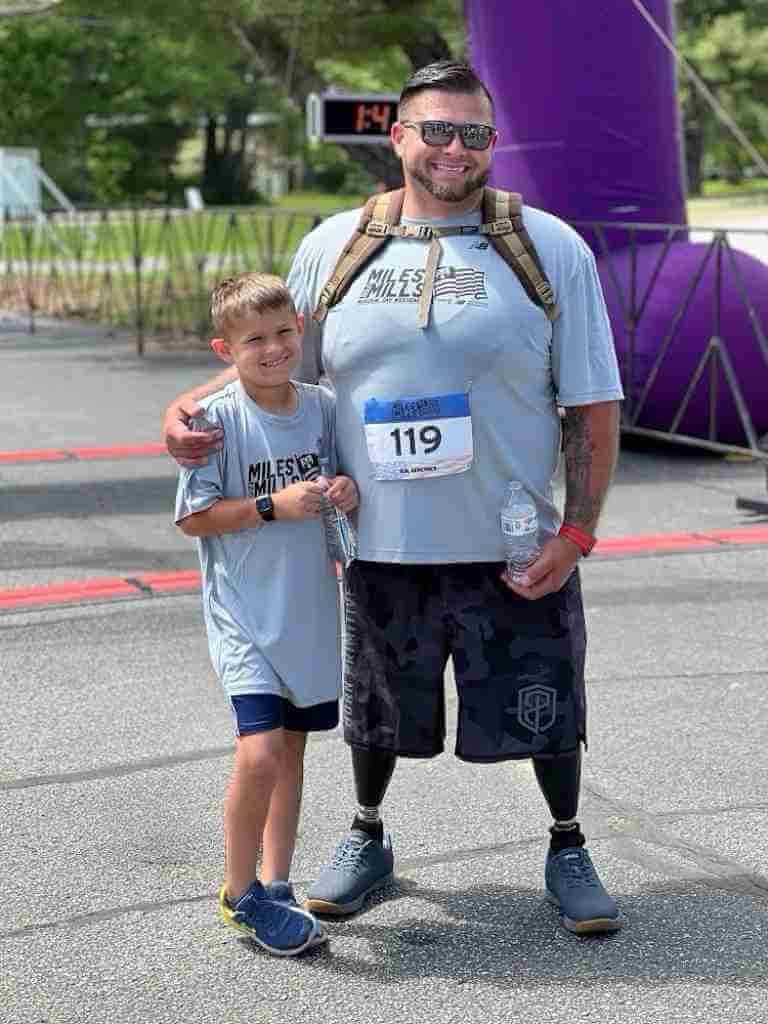
In May, he completed the Miles for Mills Memorial Day Weekend 5K, crossing the finish line as the final competitor, with his family and TMF staff by his side throughout the course.
“We did it in an hour and 45 minutes and I was really shocked,” he said. “I thought it’d take at least two and a half, three hours.”
Nick was met at the finish line by his fellow Travis Mills Foundation participants, staff, and Founder, U.S. Army SSG (Ret.) Travis Mills.
“It felt really great,” Nick said. “Unforgettable.”