
Late last month, three participants in the Travis Mills Foundation’s Warrior PATHH Program reached a significant milestone—90 days since completing their week-long initiation at the Veterans Retreat in Rome, Maine. During this 3-month journey, these women provided unwavering support to one another every step of the way.
All New England area residents, including Warrior PATHH graduates Danielle “Dani” Beauchemin, Kirsten Holley, and Kristy LiBritz, promised to stay in touch.
“Even after day seven of PATHH, we didn’t want to leave each other,” Dani said.
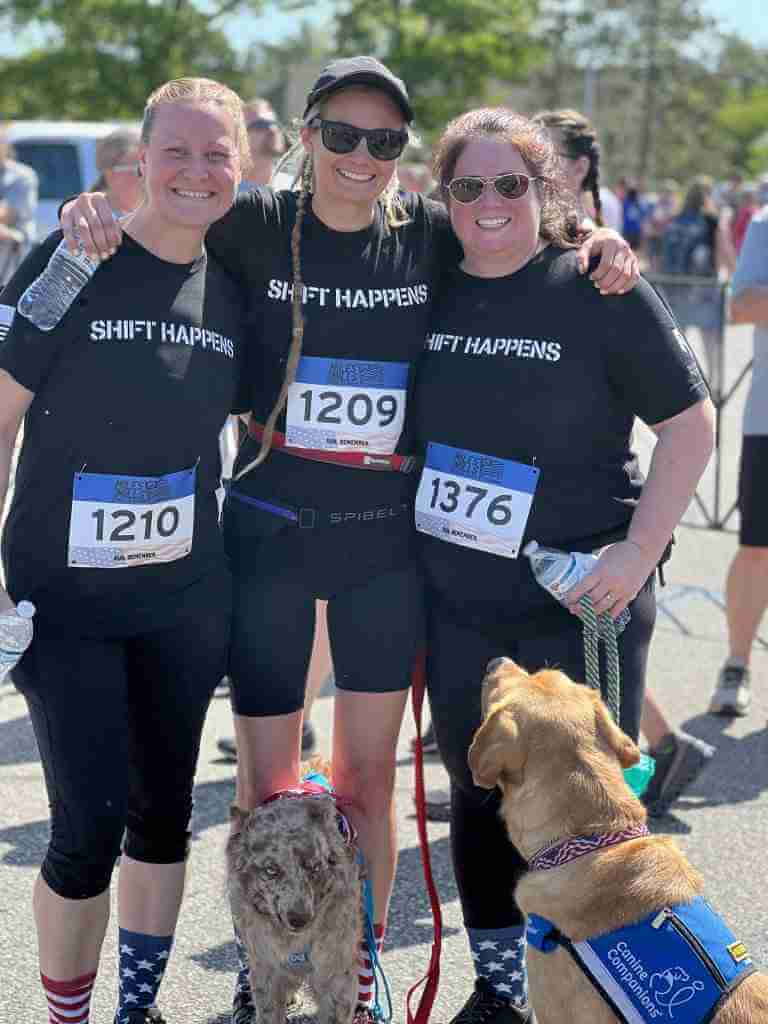
They see one another every month and in May, they ran the Miles for Mills Memorial Day Weekend Race together.
“It was neat to be able to do (the race) with these ladies,” said Kirsten. “It was really meaningful.”
All three women have experienced the profound impact of the Warrior PATHH (Progressive & Alternative Training for Helping Heroes) Program on their lives and Dani was recently hired as a PATHH Guide at the Travis Mills Foundation Veterans Retreat.
All three describe their Warrior PATHH experience as life-changing, coming at a pivotal moment when Post-Traumatic Stress had made aspects of their lives feel unmanageable.
What is Warrior PATHH?
Warrior PATHH is a 90-day, non-clinical, peer-delivered training program that begins with a 7-day intensive and immersive initiation. This is followed by 3 months of dedicated support, training, accountability, and connection from a team of trained combat veterans and first responders, all done virtually.
Dani has worked as a first responder and wilderness EMT for 10 years, often in search and rescue and emergency management. She also serves in the FEMA Reserves.
A traumatic incident on the job left Dani feeling like “an empty shell.” During this period, she described herself as extremely depressed, lost, and having zero motivation. Seeing physicians regularly helped, but it wasn’t enough.
“Going to that one-hour appointment each week was helpful, but then I didn’t know what to do with myself for the rest of the week,” she said. “I completely isolated myself from every single person in my life.”
After completing the PATHH initiation week, however, the difference was astounding.
“My friends and family saw an immediate difference from the day I got back from PATHH, and people are still noticing,” Dani said.
Kirsten felt similarly to Dani before attending Warrior PATHH, despite the difference in their backgrounds.
Kirsten transitioned out of the Army in 2019 after serving her country for a decade. Her husband was still serving in the military and her children were 1 and 3 at the time.
“Transitioning into stay-at-home mom life was very challenging for me,” she said. “We moved around a lot and over the past five years, I just really isolated myself completely from a lot of people.”
While Kirsten had been in therapy since day one of being separated from the military, she made very little progress with her feelings of depression, anxiety, and Post-Traumatic Stress.
“I also went on medication, but nothing was making me feel like me again,” she said.
Like Dani, Kirsten’s friends and family noticed an immediate difference in her after PATHH training.
“I’m a lot more open, more connected, and for the first time in five years, I feel that I’m in control of my symptoms,” she said, also describing the change as consistent.
Warrior PATHH, offered in only 10 locations throughout the U.S., not only delivers results 5-7 times better than traditional approaches to mental health, but participants report a 65 percent increase in Post-Traumatic Growth; a 61 percent reduction in depression, and a 54 percent decrease in anxiety.
Post-Traumatic Growth, explained by TMF Warrior PATHH Director James Prindle, is a positive psychological transformation that can happen after traumatic experiences.
“The science of PTG demonstrates that when we reflect on our lives and make sense of the destruction caused by trauma, our struggles can become motivation for change,” said Prindle, a Marine Corps Veteran.
Kristy, serving in law enforcement for 18 years, learned about Warrior PATHH at a Women’s Leadership Conference and through the Member Assistance Team. Three retired members of the State Police have served as PATHH Guides at TMF.
“I learned about the program there and it’s been something I’ve been able to use as a resource to let other people know about,” Kristy said. “It’s easier to help other people before you help yourself, right? I was good at that – and then I guess my tipping point was in August of last year.”
Kristy said a lot happened in a very short period of time – four of her State Troopers were hit by a car while investigating a separate call, which also happened to be on Kristy’s birthday; two weeks prior, a family emergency occurred.
“It felt like my world was unraveling,” she shared, adding that despite everything going on, no one had any idea that anything was wrong.
“It was the internal battle,” she said. “I knew I was off and pushed myself to go to Warrior PATHH.”
After the program, Kristy noticed an immediate difference in herself.
“I know myself – I could feel a huge difference,” Kristy said. “The weight lifted and there was a peace of mind that I didn’t have before.”
The Impact of PATHH
PATHH training offers a number of modules in the week-long initiation week at the Travis Mills Foundation Veterans Retreat.
Dani connected with the “good wolf, bad wolf” parable about an internal battle between the good wolf and bad wolf that is said to be told by the Cherokee.
“I was always categorizing emotions as good or bad,” she said. “What happens if you don’t feed the bad wolf?”
According to training, a life lived by indulging the bad wolf will lead to a predominantly negative life; feeding the good wolf cultivates positive emotions and taking action aligned with compassion, empathy, love, and connection.
“It taught me to accept, not categorize an emotion as positive or negative, good or bad,” Dani said. “I think about it almost every day when I have intrusive thoughts.”
For Kristy, learning self-compassion proved important.
“We’re our own worst critic at times,” she said.
All three PATHH graduates have enthusiastically encouraged fellow veterans and first responders to participate in the training.
“I feel like it’s my duty to pass on everything that I took away from it,” Dani said. “I tell them, ‘You owe yourself that chance to get on this new path; you don’t have to feel empty, isolated, and alone. All you have to do is show up – that’s it.’”
While Kirsten is mindful not to pressure anyone into exploring the training, she describes it as “life-changing” for her.
Kristy believes that by applying what she’s learned in PATHH and leading by example, she can inspire others who could benefit from the training to sign up.
“It’s also being there with them to help them take that first step,” she said. “I think the exciting part of this is showing them what is on the other end, why it’s worth putting in the work.”